

Simulation
Nimbus sits at the centre of your organisation, connecting teams around one shared business model so decisions are coordinated and fully informed.
See How Nimbus Could Work In Your Team
Make Every Financial Decision Faster and Defensible
Input
Ask Perception Console to run strategic intelligence...
Workflow cascade










Nimbus gives you a real-time, AI-powered command centre for your business, connecting every data source, modelling every scenario, and turning uncertainty into confident, profit-driving decisions.
Adopted by forward-thinking executive teams, Nimbus connects finance, operations and commercial data into a unified causal model — empowering leaders to simulate strategy, quantify ROI, and act with zero decision latency.

Simulation
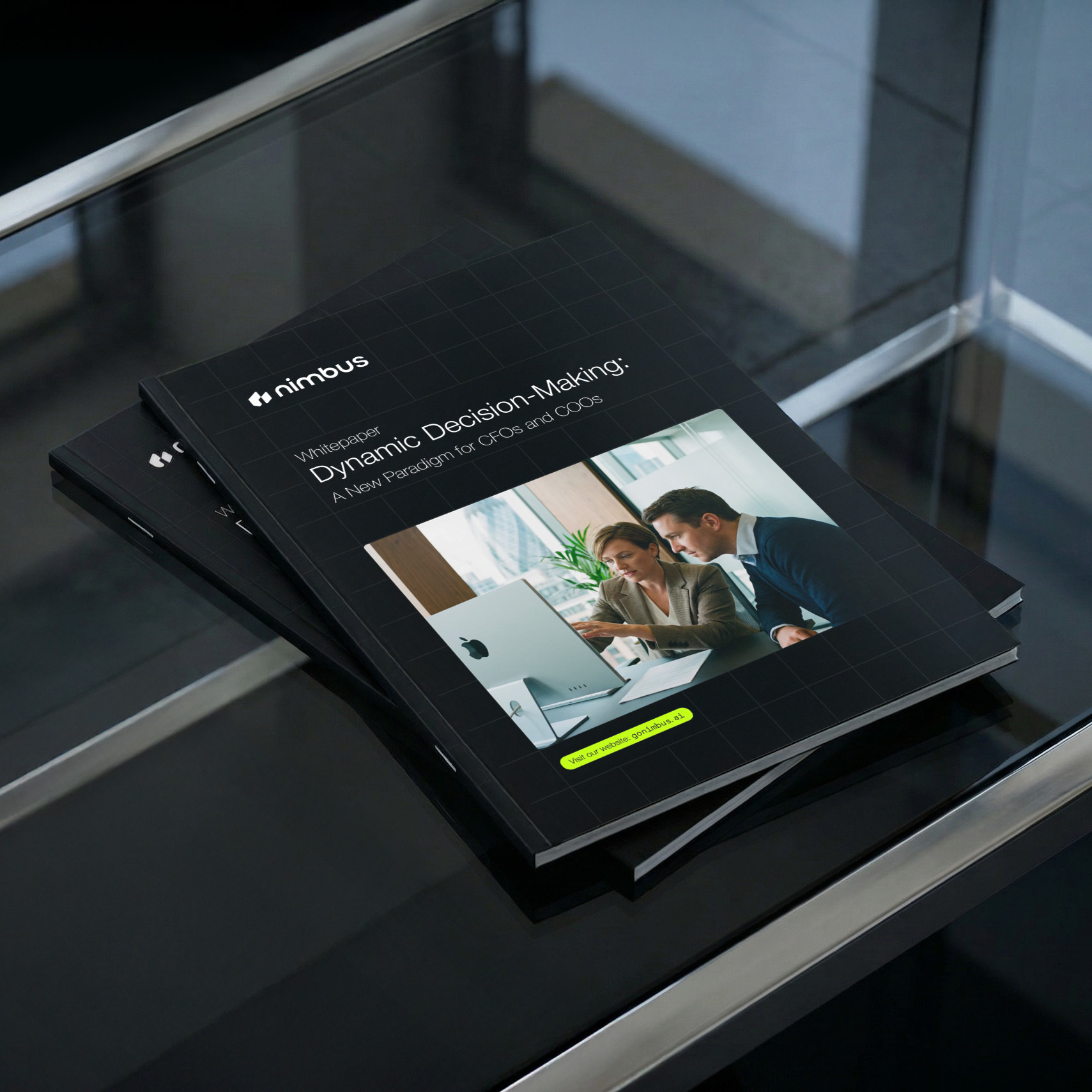
A New Paradigm for CFOs & COOs
Intelligence Infrastructure
Every operation shares organizational context. Every decision is traceable. Every outcome propagates. Nimbus connects your business processes through a shared model of cause and effect.
Learn moreFrom Manual Reporting to Decision Confidence
Nimbus replaces spreadsheet-heavy forecasting and manual reconciliations with continuously updating, interrogable decision workflows. Finance teams move from preparing numbers to confidently allocating capital, backed by full traceability and reduced audit burden.
Workflow 1 — Variance Signal & Attribution
Actual (solid) vs plan (dashed) · Amber = variance drivers · Decomposed by pricing, volume, timing
−4.3%
88%
+2.1%
+3.7 mo
Causal timeline
Variance Signal & Attribution
Variance signal feeds attribution and driver decomposition.
Attribution → Correction
Attribution feeds staged correction plan and owner assignment.
Budget Correction & Workforce Alignment
Budget updates feed spend allocation by segment.
Allocation → Guardrails
Allocation feeds guardrail enforcement and approval workflows.
Spend Allocation & Guardrails
Spend allocation committed to Workday / ERP. Closed-loop complete.
3 high-impact variance drivers identified
Revenue: enterprise segments. Margin: discount mix, expedited fulfilment. Staged correction plan.
Workflow 2 — Budget Correction & Workforce Alignment
Current vs corrected allocation · Sequenced by confidence and owner
5
6 weeks
Complete
Controlled
Causal timeline
Variance Signal & Attribution
Variance signal feeds attribution and driver decomposition.
Attribution → Correction
Attribution feeds staged correction plan and owner assignment.
Budget Correction & Workforce Alignment
Budget updates feed spend allocation by segment.
Allocation → Guardrails
Allocation feeds guardrail enforcement and approval workflows.
Spend Allocation & Guardrails
Spend allocation committed to Workday / ERP. Closed-loop complete.
Budget inputs synced
Variance signal (W1) · Workforce plan · Vendor commitments
Workflow 3 — Spend Allocation & Guardrails
Spend guardrails
Updated
Pacing rules
Aligned
Workforce caps
Revised
Vendor pacing
Guardrails set
Allocation vs plan · Green = within guardrails
Guardrails and pacing aligned with revised forecast and recovery plan
Causal timeline
Variance Signal & Attribution
Variance signal feeds attribution and driver decomposition.
Attribution → Correction
Attribution feeds staged correction plan and owner assignment.
Budget Correction & Workforce Alignment
Budget updates feed spend allocation by segment.
Allocation → Guardrails
Allocation feeds guardrail enforcement and approval workflows.
Spend Allocation & Guardrails
Spend allocation committed to Workday / ERP. Closed-loop complete.
Spend allocation inputs synced
Budget updates (W2) · Revised forecast · Recovery plan
4 categories updated
All within tolerance
How simulation-driven decision-making and digital twins can help rebuild trust and resilience in global agri-food supply chains.
Senior executives at leading OEMs recognize that today's market pressures – surging EV competition, software-defined vehicles, volatile supply chains, and AI-driven planning – demand unprecedented cross-functional collaboration. Yet most product, engineering, supply-chain, sales and marketing teams remain trapped in silos, each with its own data, assumptions and priorities.
Traditional FMCG product research methods increasingly fall short in today's fast-moving markets. Companies often rely on static dashboards, quarterly reports and one-off surveys that only capture lagging indicators of consumer behavior and market conditions.